Archive for the ‘Investing’ Category

If only we’d bought Siberia

Monday, October 26th, 2009

Just before the Iraq invasion in 2003, I commented to a friend that we should instead just buy Siberia.

Huh?  Bear with me.

At the time, oil prices were relatively low, so Russia was in difficult straits. They were short on cash, and faced a growing geopolitical threat from China, whose population outnumbers Russia by 9 to 1 across a very long, very thinly defended border.  Meanwhile, the US was still flush with credit (if not cash), able to buy what it wanted.

At that time, the entire GDP of Russia was only about $800 billion.  My proposal was that we offer them that much in cash — an entire year’s income for their entire country — in return for the coldest, least desirable, least habitable, least populated, least defensible part of eastern Russia.  And all its oil and gas rights, of course.  We would agree to defend it with only conventional forces, no missiles, no nukes, etc.

This would solve our oil problem.  Russia could hand its China problem to America. And we could stay thousands of miles away from the Middle East.

No, Russia would never have agreed to it.  The point of proposing this idea, then as now, was to put the cost of the Iraq war in perspective.  The estimated total cost of our Iraq adventure (excluding human cost) is now around $5 trillion, or 6 times the entire GDP of Russian in 2003.  Good investment?

Inviting irresponsibility

Tuesday, October 20th, 2009

The Wall Street Journal reported today that the IRS is seeing massive fraud in the homebuyer tax credit.

The article mentions something I hadn’t noticed:  the tax credit is refundable, which means that if you don’t owe any tax, then the government actually pays you.  This one fact brings the whole picture into focus, and reveals what a bad idea the credit and other incentives are, even without borrower fraud.

Let’s say you are a renter with a short planning horizon, no understanding of finance, and no moral compass, other than a desire to avoid jail time. Carpe diem, dude!  One day, the government offers you a rich tax credit for buying a house. The FHA is falling over itself to offer you a subsidized loan.  A friendly homebuilder points out that, if you buy enough house, your interest deduction will exceed your income tax obligation.  This lets you stop all your salary withholding right now(!), and you’ll still actually collect $8,000 in April.  Maybe the builder even happens to know someone — unaffiliated, naturally — who will lend you the down payment.

Carpe Diem Dude’s perspective:  you pay nothing down, and immediately get a new house, a 25% raise in take-home pay (which mostly goes to the mortgage payment), plus an $8,000 check next April.  If you wipe out and default, well hey, that’s a long time from now — months, maybe — and it was never your money anyway.  Besides, you keep the $8,000.  Why not?

Friendly Homebuilder’s perspective:  you get a desperately needed home sale, which saves your job.  It costs you and your company nothing, assuming that you jacked up the purchase price by enough to pay your cousin Icepick to loan the down payment to Carpe Diem Dude (oops, did I say that, or just think that?).  If the buyer defaults, hey, it’s the FHA’s money, no harm no foul.

FHA’s perspective:  you are a government-backed agency receiving constant pressure to write new loans. Your Congressional taskmasters say publicly that writing bad loans is the policy, so keep up the good work.  And hey, if it all comes apart, you were just following orders.

This is an incredibly great deal!  If only I didn’t already have a house.  Is there an age requirement?  Maybe my elementary school-age kids can each buy a house…

Has college become a bad investment?

Monday, October 19th, 2009

Private college appears to deliver negative lifetime return on investment to most attendees.  Provisos are itemized below, so please resist your instinct to recoil, and read the whole thing.

The Census Bureau reported in 2002 that the median college grad’s income was $45,400, compared to $25,900 for the median high school grad.

The College Board reported in 2006 that private college consumed an average of 5.3 years of the student’s time.  Public college took 6.4 years.

I made these rough assumptions:  40-year working life;  discount rate of 8%;  fully loaded tax rate of 30%, including all mandatory payments to all levels of government.

Based on those sources and assumptions, the after-tax present value benefit of a private college degree is about $65,000. That’s total, not per year.

Unfortunately, college costs much more than that — the College Board says the average is $53,000 $69,000 in tuition and fees alone, including all financial aid, before food and rent.  Add in living expenses, and you’re far beyond $65,000.

So it appears the return on investment is very likely negative for most families, and even more negative if we consider the cost of the subsidies.

What this argument isn’t

This is not an argument for more aid, nor less aid.  ROI (return on investment) appears negative regardless of whether tuition is paid by the parent, student loans, scholarships, or the government.  The problem is not financing or subsidy levels, but the fundamental cost/benefit equation.

This is not bashing private colleges.  I have degrees from three, and I’m glad.

Caveats

NPV is a dubious instrument, highly sensitive to tiny estimation errors in the discount rate.  You can prove anything by turning that dial.  But note that the discount rate would have to be below 6% to justify anything like the median cost of private college today.  It doesn’t add up.

College offers the option value of attending graduate school, which is not reflected in this calculation.

College may have indirect benefits not captured by NPV.

College may have positive externalities for society as a whole, not measured here.

The latest census data on income is several years old, which could invalidate the result.  But I believe it still holds true, because incomes are purportedly nearly stagnant.

Conclusion

There are plenty of ways you could pick this apart, but it’s rearranging deck chairs on an investment Titanic: the answer is so far below zero that you have to make flattering assumptions for private college to look sensible.

Pretty sobering, because it was almost certainly not the case a generation ago.

Public college ROI might be better or worse:  tuition is lower, but since it is internally subsidized, we do not know if the actual cost is lower (though I suspect it is). We do know that students spend much longer attaining a degree there, causing more foregone income.  Could go either way.

More thoughts on college ROI (obsolete)

Wednesday, October 14th, 2009

(Note:  the contents of this post were later replaced, corrected, expanded etc. here.)

This follows up on last week’s assertion that many private colleges are a bad investment, viewed from a purely financial perspective.

Obviously college has more than mere financial benefits.  But those additional benefits are of interest mainly to families that are already somewhat prosperous and educated.  If you agree that much of the value in affordable college education is to help people up the economic ladder, then you must also agree that such people are mainly interested in return on investment — it’s tautological.

In the previous post, I suggested that the cost of servicing college debts was often greater than the financial benefit of college.  This post is more general:  it argues that the net present value (NPV) of an investment in college, no matter how it is paid for, will often be less than zero.  This is the mathematical definition of a bad investment.

Caveat:  be suspicious of NPV arguments, as I’m about to present here.  The NPV equation is inherently unstable.  Its terminal value contains the term (1+g)/(r-g), where g is the growth rate and r is the discount rate, is obviously extremely sensitive to the choice of discount rate.  It’s a tiny number in the denominator — little changes make a big difference.  Tweak that knob a little bit, and you can prove almost anything.  This little arithmetic detail is the precise reason that huge companies make foolish mergers — but that’s another story.

Studies supposedly show that college increases median income by about $19,000.  But that’s pretax.  The after-tax benefit is more like $12,500.  This should really be reduced further to reflect alums who end up not working, but let’s ignore that for now.

We’ll choose a discount rate of 8% — actually quite low, only 3% over a reasonable long-run risk-free rate, on the presumption that one’s income is increased with high reliability by going to college.  This yields a present value for a 40-year working life of about $150,000.

Thus the maximum tuition you should be willing to pay for a “median” college education should be $150,000, or $37,500 per year, assuming no tuition increases.

Uh oh.  The College Board says the average student in 2005 took 5.3 years to complete private college at $30,367 per year, or a total of $152k.  Conclusion:  private college is a bad investment in many, probably even most, cases.

We’re being very generous here — the true situation is almost certainly worse.  For example, the unemployment rate among new alums is now ~20%, so we should reduce the first-year median income by that amount.  This cuts PV to $140,000.  As another example, interest rates are highly likely to be unusually high over the next 20 years.  If the discount rate is 12%, then the maximum logical college expense (tuition plus all expenses) is only $104,000.

Again, the point is that this suggests a low or negative return on investment for expensive second-tier private colleges, regardless of who pays, or how. Whether the government pays, or the school, or your parents, or you borrow tuition from Sallie Mae, the answer is the same:  low or negative return on investment.

A few silver linings:  personal choices can greatly affect outcome.  The levers are the choice of school, choice of major, and number of years spent there.  If you go to a private school known for good placement, then major in something marketable, and then place out of your freshman year with your good AP test scores, then you’re going to do fine.

For everyone else, it looks like the whole system needs a radical overhaul.

Stock market in pictures

Tuesday, October 13th, 2009

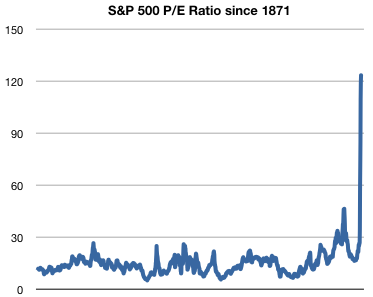
PE1871-2009
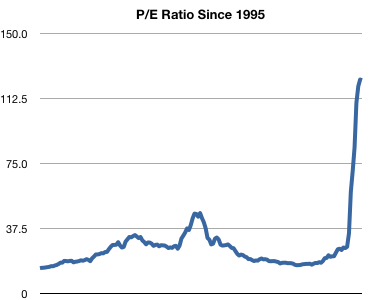
PE1995-2009

If this doesn’t alarm you, then nothing will.  Why?  Because P/E ratio is a simple and more or less proven predictor of long-term stock market returns.  Lower is better.  When P/E is 10 times greater than the 138-year average, and 3 times its previous all-time peak, when interest rates are already zero, we are in totally uncharted waters.

The one bright note for stock market investors is that the S&P500 is a weighted index. The financial sector contributed a big chunk of the overall index profits, and most of that went away.  So one interpretation of these graphs is that certain ultra-large-cap stocks are fantastically overpriced, even as many smaller value stocks are still fairly priced.

At minimum, this appears to argue strongly against holding a traditional S&P index fund.  One may do significantly better by owning a low-PE index fund like Vanguard Small-Cap Value Index (VISVX).

(Data source:  Yale economist Robert Schiller’s data series.  Monthly earnings are interpolated from quarterly.  Data set comprises the S&P 500, and an equivalent broad index prior to 1957.  The idea for these graphs came from similar ones posted at Jesse’s Cafe Americain, though he was making a different point I don’t necessarily agree with.)

Thoughts on college ROI (obsolete)

Thursday, October 8th, 2009

(Note:  the contents of this post were later replaced, corrected, expanded etc. here.)

I heard this week that Georgetown University now costs $65k per year, all in.  I verified it afterward:  tuition is $35k, the rest living expenses.

Costs are similar at many private schools.

You see gee-whiz stories like this all the time, but I’m not going to do that.  Let’s try a little arithmetic instead.

Let’s say you borrowed the entire cost of a 4-year private college education, as many people do.  Student loans are 30-year amortized, just like home loans, so at 5% interest, your payment is about $1400 a month for 30 years.

But that’s an after-tax expense.  Student loans get almost no tax deduction; let’s say you qualify for the maximum deduction, $2500 per year.  Result:  your PRETAX cost to service that debt is a bit over $24,000 per year.

Here’s where it gets interesting.  The median college graduate’s income is about $45,000 per year, while the median high school grad’s income is $26,000.

In short, college increases your pretax income by a median $19,000.  You then pay out $24,000 on those student loans, and… well, I hope you learned enough arithmetic at that fancy college to realize YOU ARE HOSED to the tune of a $5,000 net loss per year, for the next 30 years.

Even the above dramatically understates the problem, because it ignores that the high school grad pays a much lower marginal tax rate;  that tuition is still rising faster than incomes;  and, most importantly, that the interest rate on your student loans in the future is highly, highly likely to be much higher than 5%.

In short, it doesn’t work.  It can’t work.  Unless you have a full scholarship or wealthy parents, you have only a few logical choices.

  1. Go to an inexpensive public university.
  2. Go to a top-tier private school that is highly likely to increase your income by much more than the median.  It’s Ivy League or bust — literally.
  3. Choose only a major that pays far more than the median.  Art history majors, be afraid.
  4. Borrow the full amount, then default and skip the country.
  5. Don’t go to college.

Tough decisions coming, folks.  And to think that, just a couple of years ago, your hardest choice was, “Escalade or Navigator?”  HELOC-funded, of course.

Krugman on Schumpeter

Tuesday, October 6th, 2009

Krugman wrote the other day that Schumpeter’s macroeconomics falls apart because:

[Schumpeter says] mass unemployment is necessary, because you have to shift resources away from sectors that got too big, stimulus is a bad thing because it slows the necessary adjustment. And now as then, the whole notion falls apart when you ask why, say, a housing boom — which requires shifting resources into housing — doesn’t produce the same kind of unemployment as a housing bust that shifts resources out of housing.

Thus urged, I did ask myself why there would be unemployment in a housing bust, but not a boom.  The answer, Mr. Krugman, seems pretty obvious:

  1. Investment bubbles collapse much faster than they inflate.  In the real world, labor can only redeploy so fast.  If capital reallocation exceeds that rate, you get unemployment.  So on the way up, capital redeploys slowly enough for labor to react smoothly.  No unemployment.  On the way down, capital redeploys much faster than labor can.  Presto, unemployment.
  2. (more speculatively)  In the short run, bubbles increase the blended rate of return on capital for the whole economy.  Higher ROI permits overall employment to rise above the rate that would have prevailed without a bubble.  When it bursts, ROI falls, so unemployment rises.

Uptick roolz

Tuesday, April 7th, 2009

Wonder why the market is up 25% in a single month, despite no improvement in fundamentals?  Consider this interesting coincidence.

The recent huge market rally began March 10, the same day Barney Frank announced the imminent, nearly certain elimination of the short uptick rule.  Berkshire Hathaway, a popular short in recent months, rose 19% that day.

Meanwhile, judging from what clients tell me, a lot of big funds lately are simply speculating on short-term momentum.

Connect these two dots:  massive short covering began March 10, anticipating the end of the uptick rule.  This caused a mini-rally.  Big momentum investors reacted to that, and to each other, creating self-sustaining momentum.

Result:  sustained rally on no fundamentals.

Not saying that’s definitely what happened, but it is a simple and plausible interpretation of events.  More plausible, in fact, than an abrupt improvement in the economy or financial system.

Credit card optimization and inflexibility

Friday, March 20th, 2009

I’ve mentioned before the general principle that optimization creates inflexibility — in business, investing, computer programming, law and much else.

The credit card industry’s current travails offer an example.  Many have written on this subject recently, many good, but usually with the leftist or moralist subtext that 30% interest rates are somehow inherently wrong, so card issuers are getting what they deserve.  I’ll leave the Biblical debates to other writer.  This post just talks about the relationship between steady-state profit maximization and brittleness in economic shocks.

Credit card issuers mainly make money from so-called “revolvers” — people who endlessly pay interest on high balances, too high to pay down, but never quite high enough to trigger  default.  The issuer’s business revolves around revolvers, endlessly optimizing to maximize cash extraction from that particular group.  (Conceptually similar to the way casinos make much of their money by catering to and optimizing for “whales,” a gaming industry term for high-stakes compulsive gamblers.)

The 2005 bankruptcy reform, in force since 1/1/06, was intended as yet another credit card industry optimization.  By making Chapter 13 harder to qualify for, debtors could not easily write off consumer even in bankruptcy.  Instead, they were placed in repayment programs by the bankruptcy court.  According to at least one reliable source, issuers responded to this by lending more freely, assuming they would always be able to collect, even in bankruptcy.

This and other optimizations were in a sense too successful:  the more effectively the issuer optimizes, the closer it pushes the “revolver” to his absolute theoretical fiscal limit, the more exposed both borrower and issuer become to an economic shock.

Say you are a lender.  Would you want most of your customers to be paying you 100% of their EBIT in interest payments?  A residential lender would answer no.  Corporate bond issuers would say “no way.”  Too dangerous, no margin of safety.  A one-dollar decrease in the borrower’s income would trigger default.  Yet card issuers were actively seeking that 100%.  They tried to control losses with higher rates and better collections, but mainly just crossed their fingers on general economic stability.  That turned out to be an ill-placed hope.

What if it's all about transparency?

Saturday, February 21st, 2009

As we launch into the biggest Keynesian stimulus in history, it bears mentioning that no one really knows if that stuff works.

Here is an alternative explanation, merely an assertion presented without evidence.  Judge for yourself.

High debt and unknowable exposure don’t mix. If you have low debt, you can tolerate uncertainty about exposure and risk. If you have high debt, you can still take risks, but critically, you need to know exactly where your exposure is, how big it is, or you quickly become insomniac and sensitive to loud noises.

Repeat:  if you have high debt, unknowns may be OK, but unknowable unknowns are not.

“How bad is it right now?” ask investors, consumers and managers. If they can’t answer the question even approximately, then they must assume the worst. When you aggregate those assumptions together, you get a depression.

The obvious policy response is to massively increase the transparency of such exposure. That may bring bad news, but according to Adam Smith (remember him? policymakers sure don’t), individual agents are quite efficient at working around problems, if they know what they are.

This seems to be a forgotten lesson of the Great Depression. “The only thing we have to fear is fear itself.”  What fear? Unknowable unknowns. For example, how safe is your bank?  Are you really getting market price from your broker when you buy a stock? Everyone thought they knew the answers in 1928, but found they could not estimate them even approximately in 1931.

One of the primary policy responses then was to make risks more knowable. For example, consider banking regulation. If a depositor knows his bank must disclose its exposure in great detail to the federal government, his loss exposure is not zero, but it is somewhat predictable. This transparency is actually more useful than deposit insurance, because it guides good decisions for both banks and depositors, without moral hazard on either side.

Now investors, managers and consumers are faced again with a sudden tidal wave of unknowable uncertainty.  They thought they knew these basic things, and now realize they know nothing:

  • What is the true default risk of a Moody’s AAA rating?
  • What is the resale value of this or that mortgage-backed security?
  • What is the true financial position of my bank, insurance company or broker?

Throwing money around doesn’t address the problem. No matter what the Fed or Treasury does, the credibility of the credit rating agencies is still suspect. No one knows what certain unregulated securities are worth. Again, high debt is intolerable without transparency.  Until transparency is restored, everyone will still be racing to deleverage, and the ship will keep going down.

Here are some specific actions, which could be taken immediately, that would help restore transparency, permitting all those little rational agents to resume their business:

  1. Create a regulatory agency specifically overseeing credit rating agencies.  Enforce limitations on conflict of interest.  Force one more re-rating of all MBS.
  2. Create a federal mortgage-backed security information website.  Display the contact info of any entity owning more than 10% of a given issue.  Display the deal terms.  Display the actual individual properties held by each mortgage-backed security, scrubbed of personal info, but  still showing 9-digit zip code, square feet, and so on. This would permit anyone to value any MBS, and to contact major owners to make offers.
  3. Several months later (after there has been time to absorb the information), require at least one US exchange to offer a listed market in MBS, displaying bid/ask prices publicly.
  4. Several months later (again, for info absorption time), require all banks and all public companies to disclose their specific MBS holdings.  On the balance sheet, they may either mark to market or hold to maturity, but in any event, must disclose all individual holdings.

The above would drain the swamp in MBS and the rating agencies.  Yes, it would be ugly.  Banks would fail.  But, er, at risk of stating the obvious, if they are holding bad assets, they will fail anyway.

These are the sorts of changes that would bring a true solution.